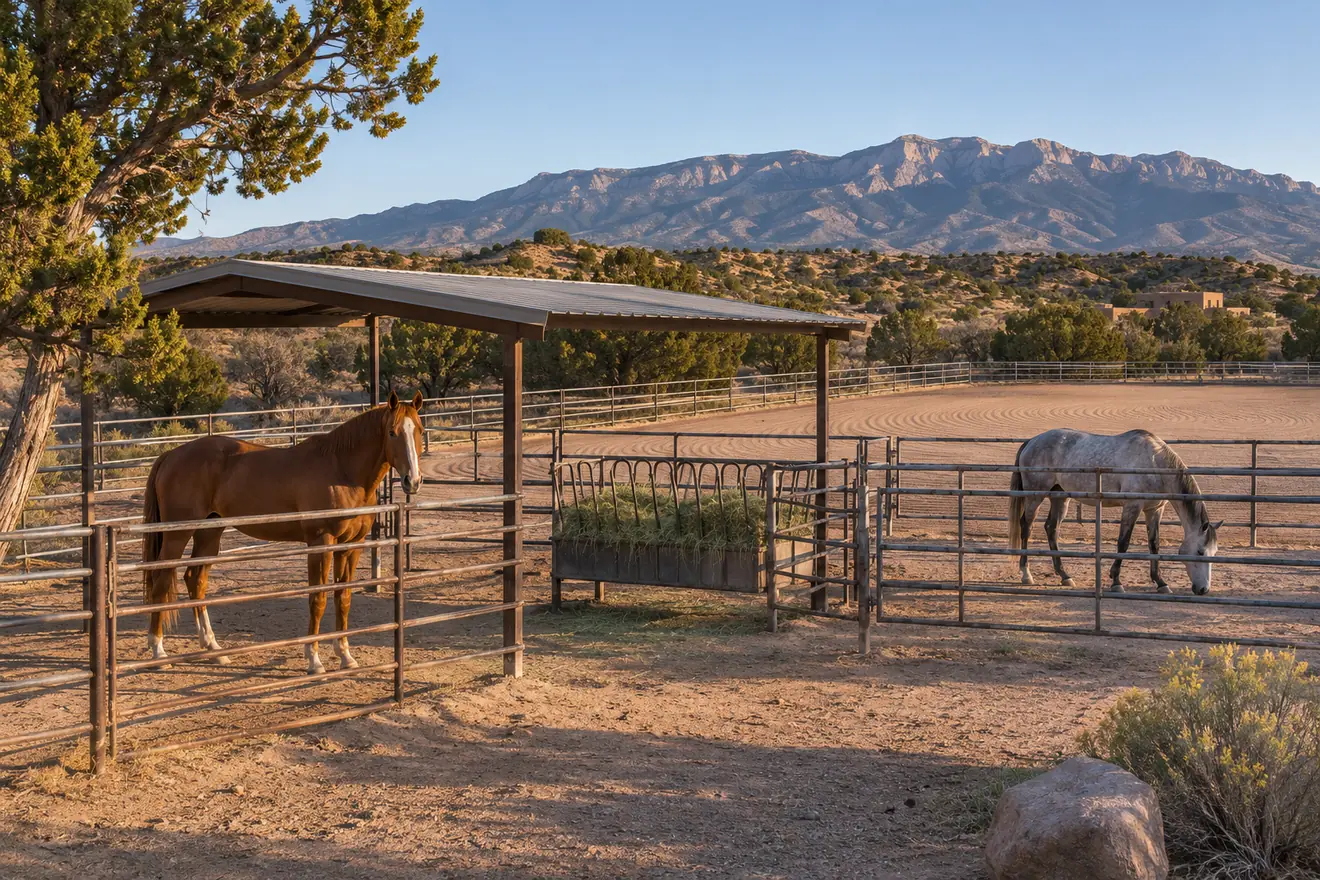
Most people searching for horse property in Placitas carry the same picture in mind: horses at the back fence, an arena in the morning light, and no drive to a boarding barn. That picture is real and achievable on the right parcel in this corridor. But it describes one point on a spectrum, not the only way to keep horses in this part of New Mexico.
Boarding - paying a facility to house, feed, and care for your horse off your own land - is a practical choice at several points in a horse owner's life. It serves buyers who have not yet closed on a property, owners who are mid-renovation on fencing or water infrastructure, people whose work schedule makes twice-daily care unworkable, and a smaller but real group for whom permanent boarding at a well-run facility simply makes more economic sense than maintaining a full private horse setup. This guide covers the boarding landscape in and around Placitas: how the main board types differ, what facilities exist in the area, what a solid contract must include, what rates look like in this corridor in 2026, and the situations where boarding beats buying.
Why Placitas Horse Owners Consider Boarding
The Placitas corridor - stretching roughly from Bernalillo up through the Sandia foothills to the Upper Placitas mesa and the parcels along NM-165 - is primarily owner-kept horse country. Five-acre and ten-acre lots dominate the market, and most buyers arrive intending to keep horses at home from the start. But the gap between intention and readiness is wider than it looks from outside.
New arrivals relocating from out of state face an immediate infrastructure question: is the property actually ready for horses today? A well and pressure tank that has not been tested under horse demand, fencing that needs upgrading from cattle wire to horse-safe board or no-climb, a pasture that has been overgrazed and needs a full rest season, a barn that is planned but not yet permitted - any one of these can delay bringing horses home by weeks or months. During that window, a boarding facility in the area bridges the gap without putting animals in a compromised environment.
Existing owners face the same calculation at different points. A freeze that cracks a tank line, an extended human injury recovery, a family situation that makes the twice-daily feeding schedule untenable, an arena that needs regrading after a wet summer - these are recurring reasons why even well-equipped property owners use boarding temporarily. The desert environment in Placitas is not forgiving when daily care lapses.
A smaller group makes the full commitment to permanent boarding. These owners want to ride, not to maintain infrastructure. For them, the right facility handles daily care while they enjoy the equestrian community and the Sandia foothills trails. That is a legitimate choice, and when examined honestly against the full cost of building and operating a private horse setup on a Placitas parcel, it is sometimes the more financially sound one.
Types of Board Available Near Placitas
Commercial horse boarding in the United States is sold in three main structures: full board, partial board, and pasture board. Each represents a different division of work and cost between the facility and the horse owner. Understanding these structures before making contact with any barn saves confusion and helps owners ask the right questions.
Full Board
Full board means the facility handles essentially everything: stall or dedicated turnout housing, feeding (typically twice daily with hay, plus owner-supplied grain and supplements), daily mucking, water, and routine observation for signs of illness or injury. Most full-board contracts include a dedicated stall with daily access to a paddock or pasture, and many include shared arena or round-pen use.
For horse owners who travel regularly, work demanding schedules, or simply prefer not to be tied to a twice-daily obligation every day of the year including holidays, full board is the cleanest arrangement. The tradeoff is cost and reduced direct control. A full-board relationship depends heavily on barn staff knowing your horse - recognizing early signs of lameness, following medication schedules, spotting changes in appetite or behavior. The quality of that staff relationship matters more than any single amenity. A facility with attentive, experienced staff and modest infrastructure is a better choice than a beautiful facility with high turnover and distracted management.
In the Placitas and greater Albuquerque corridor, full-board rates in 2026 generally run between $500 and $900 per month for a standard stall setup. Rates vary significantly by facility quality, included services, and location. Verify current rates directly with any facility before planning around any published figure, since hay costs and staffing changes affect what barns charge on a rolling basis.
Partial Board
Partial board splits daily care between the facility and the owner. A common arrangement is that the barn feeds and waters but the owner mucks, provides some feedings per week, or covers certain care tasks. Some partial-board setups trade reduced cash cost for a fixed number of labor hours at the barn each week. The specifics are more variable than full board, and the contract details matter more as a result - exactly who does what on which days should be in writing, not understood verbally.
Partial board suits owners who want to stay closely involved with their horse's care but need coverage support, particularly during busy periods or travel. It also works well for owners who want direct control over feeding and health monitoring without carrying the entire burden alone. Expect partial-board rates to run roughly $100 to $200 per month below the full-board rate at the same facility, though this varies.
Pasture Board
Pasture board is the most economical structure and the most common in rural areas like the Placitas corridor. The horse lives outside year-round in a shared or individual pasture, receives communal hay feedings, and has access to a run-in shed or shelter. Mucking is minimal compared to stall board. Daily interaction with barn staff is lighter.
The appeal is cost and lifestyle. Horses in pasture board often live in conditions closer to their natural state - moving freely, socializing, maintaining joint health through constant low-level movement. The drawback is reduced individual monitoring. A horse in an eight-horse pasture requires an observant owner who visits regularly, because early signs of lameness, weight loss, or injury can be missed in a group setting. This is especially relevant in the Placitas area, where rattlesnake encounters, cholla cactus embedded in legs, and puncture wounds from sharp desert terrain can go unnoticed for a day or two in a large pasture setting. Plan to visit at least three to four times per week under any pasture board arrangement.
In the Placitas corridor and surrounding Sandoval County, pasture board runs between $200 and $450 per month in 2026. The wide range reflects differences in pasture quality, supplemental hay, water infrastructure, and how many horses share the space. Verify any rate directly before committing.
Boarding Facilities In and Around Placitas
The Placitas area is not saturated with commercial boarding operations the way larger equestrian markets are. The corridor is overwhelmingly private horse property rather than boarding-focused, which means commercial facilities are fewer and openings fill quickly. Knowing what exists, and where to look when listings run thin, is worth understanding before a boarding need becomes urgent.
Facilities Within Placitas Proper
Diamante Equestrian Center, located on Camino De La Rosa Castilla in Placitas, is one of the most prominently listed boarding facilities within the community itself. As with most small private operations in rural New Mexico, specific rates, board types, and current availability change frequently. The facility appears in multiple regional horse boarding directories. Calling directly to confirm current availability and pricing is the right first step.
Lazy Coyote Ranch is another Placitas operation that has offered boarding and trail access, with a background as a horse rescue facility. Hobby farms and former rescue operations in rural areas sometimes carry boarding clients on an informal or limited basis. These arrangements can work well for the right fit, but require a clear written contract regardless of how casual the introduction feels - a handshake arrangement is not a boarding contract, and the absence of written terms creates problems for both parties if anything goes wrong.
When searching for facilities in Placitas proper, local equestrian networks are often more current than online directories. The riding and trail community in Placitas - the same people involved in the area's shows, clubs, and organized events described elsewhere on this site - maintains informal knowledge about which barns have openings before those openings are ever posted publicly. Connecting with other horse owners in the community is frequently the fastest path to current, accurate options in a market this small.
Nearby Facilities Within 20 Miles
Caballo Creek is listed as a boarding and layover facility roughly ten miles from Placitas, with stall boarding and trail access. Facilities that primarily advertise as layover operations - serving horses in transit - are worth calling even when you need longer-term board. Many will arrange monthly arrangements for local clients when stall capacity permits.
The North Valley and Corrales corridor, west of I-25 along the Rio Grande, carries a denser concentration of boarding facilities than Placitas proper. Cottonwood Stables and several smaller private operations in the Corrales area are within 15 to 20 miles of central Placitas. The North Valley has long been Albuquerque's most established horse country, and facilities there are generally more built-out than smaller rural operations, often including covered arenas, wash racks, and more structured staffing. The drive from upper Placitas to Corrales runs about 25 to 30 minutes, which is manageable for owners who plan daily visits.
The South Valley, farther down Albuquerque near Rio Bravo, offers more affordable options with less commute appeal from Placitas. Spur Stables on Lakeview Road SW in Albuquerque has published monthly boarding rates around $285 per month, with daily mucking and feeding included, plus arena and ditch access to the Rio Grande River. They also offer overnight layover board at approximately $35 per night - a useful option when a horse needs short-term housing during a move or veterinary recovery. Verify current rates directly before planning around any published figure; these numbers reflect publicly available information and shift with operating costs.
A Note on Cieneguilla Stables
Readers who arrive at this page searching for "Cieneguilla Stables" in connection with horse boarding near Placitas should know the following: Cieneguilla Stables is an established horseback riding operation located at approximately 2961 NM-68, near Embudo in the Rio Grande Gorge area south of Taos. That places it roughly 90 miles north of Placitas. The business operates guided trail rides and horseback experiences open to the public - it is not a commercial boarding facility in the traditional sense and is not set up for monthly residential boarding of privately owned horses.
The name resonates in the Placitas area partly because "cieneguilla" is a Spanish place-name element used throughout northern New Mexico to describe small wetland or boggy areas, and the word appears in several Sandoval County place names near the Placitas corridor. If a Placitas-area resident is looking for boarding close to home, the Embudo operation is not the right destination. The resources listed in this guide - in Placitas, Corrales, the North Valley, and the South Valley - are geographically appropriate.
What a Boarding Contract Should Cover
A well-drafted boarding contract protects both the horse owner and the facility. In New Mexico, equine activity liability is shaped by the state's Equine Liability Act (New Mexico Statutes Annotated, Chapter 42, Article 13), which limits liability for equine activity providers for injuries arising from the inherent risks of equine activities. That statute includes specific notice and warning requirements that must appear in contracts and be posted on the premises. Readers should verify the current status of that statute with a New Mexico equine attorney before signing or drafting any boarding agreement, as statutory details can change.
Beyond the liability framework, a thorough boarding contract should address the following:
- Horse identification. The horse's name, breed, age, color, and distinguishing markings. Photographs attached as an exhibit are useful and reduce any dispute about which animal is covered.
- Board type and services included. Exactly what the monthly rate covers - stall vs. pasture, number of daily feedings, type and quantity of hay, turnout schedule, arena access, blanket on and off service, fly spray application. Any service not explicitly listed in the contract is not covered, regardless of what was discussed verbally.
- Payment terms. Monthly rate, due date, late payment penalty, and what happens if board goes unpaid. New Mexico does have an agister's lien framework that allows boarding facilities to hold a horse for unpaid board. Understanding this provision before a problem arises protects both parties.
- Veterinary and farrier authorization. Who may call a vet in an emergency, the dollar limit the facility can authorize without owner consent, and which farrier is used by default. If the owner has specific providers they want used, those should be named. Access to a preferred veterinarian is a practical consideration when evaluating any facility; the horse vet and farrier guide for the Placitas area covers which practices serve this corridor.
- Emergency contacts. At least two current phone numbers for the horse owner, plus a designated backup contact who can make decisions if the owner is unreachable. Update these if numbers change.
- Insurance language. The facility will typically carry general liability on the property; the horse owner should maintain mortality and major medical insurance on the horse. Confirm whether the facility requires proof of equine insurance as a condition of boarding.
- Termination provisions. How much notice either party must give to end the arrangement (30 days is standard), and what happens to the horse if notice is given but the owner does not remove the horse within the specified window.
- Liability release and statutory warning. New Mexico law requires specific warning language to be included in releases for equine activity providers. Any contract presented without this language should be reviewed by an attorney before signing.
A horse owner boarding for the first time, or boarding at a new facility for the first time, is well served by having a New Mexico equine attorney review the contract before signing. Even a one-hour consultation can identify missing terms. The cost is small relative to the exposure a poorly written boarding contract creates for a horse worth several thousand dollars or more.
Typical Monthly Costs in the Placitas Corridor
Published boarding cost guides are useful for calibration, but they lag behind market conditions and tend to smooth over the range that actually exists in a small regional market. The honest picture in the Placitas corridor in 2026 is as follows, with the caveat that any specific rate must be confirmed directly with the facility:
Statewide, industry aggregators in 2026 report a New Mexico boarding range of roughly $185 to $1,000 per month, with a median around $450. That range is real - New Mexico spans everything from bare-bones pasture setups in rural eastern counties to well-staffed show facilities with covered arenas in Santa Fe and the East Mountains. The Placitas corridor occupies the middle portion of that range.
- Pasture board in Sandoval County and Placitas proper: Roughly $200 to $450 per month. Rates reflect hay quality, water access, pasture size, and supplemental feed included.
- Full stall board with arena access in the Placitas and Corrales corridor: Roughly $500 to $850 per month. Facilities with covered arenas, full-time staff, and consistent management will be at the higher end.
- Albuquerque South Valley operations: Some published rates as low as $285 per month for straightforward stall board with daily feeding and mucking, though amenities at this price point are limited.
- Santa Fe corridor, for reference: Full board at established facilities in the Santa Fe area published at $1,000 to $1,250 per month as of late 2025. The Placitas market runs meaningfully below the Santa Fe market in most categories.
The monthly board rate is not the whole cost picture. Additional expenses that commonly appear outside the base rate include:
- Farrier: Trims every six to eight weeks, or shoeing if the horse works on rocky Sandia foothills terrain. This is an owner-paid expense in almost all boarding arrangements. For current regional farrier costs, see the vet and farrier guide for the Placitas area.
- Veterinary care: Routine wellness visits, vaccinations, Coggins testing, dental floating. The boarding facility does not cover these costs under any standard board arrangement.
- Feed supplements: Most board rates cover base hay. Grain, joint supplements, electrolytes, and specialty feeds are owner-supplied and owner-funded.
- Blanketing service: Some facilities charge separately for blanket on and off service, particularly during Placitas winter nights when temperatures can drop into the teens at upper elevations.
- Trailer parking: If the owner trailers in regularly for arena rides, ask upfront whether parking a trailer on the property is permitted and at what cost.
A realistic all-in monthly cost for a horse in full board in the Placitas corridor - including base board, farrier on a trim schedule, and routine veterinary - runs between $700 and $1,100 per month for most owners, depending on the horse's health status and needs in a given month.
When Boarding Makes More Sense Than Buying
There is a persistent assumption in horse-owner culture that boarding is a temporary compromise and property ownership is the goal. That framing is worth examining honestly, especially in a high-desert market like Placitas where infrastructure costs are real and the work of daily horse care in an arid environment with cold winters and intense summer heat is not trivial.
The following situations are ones where boarding often makes more economic and logistical sense than maintaining horses on private property:
You Have One Horse
The overhead of building and maintaining proper horse infrastructure - a solid barn or shelter, appropriate high-desert fencing, a reliable water system that handles winter freezes, hay storage that keeps forage dry, and an arena if training or regular riding is part of the plan - is roughly the same capital investment whether you have one horse or four. Spread over one horse, that capital cost is expensive on a per-horse basis. At two to three horses, the math of ownership starts to improve. At one horse, permanent boarding at a well-run facility may cost less in total annualized expense than the carrying cost of a horse-ready property in Placitas, once property taxes, maintenance, water, hay delivery, and time are factored in honestly.
Your Schedule Involves Regular Travel
Horse ownership in rural New Mexico ties a person to place with unusual rigidity. The animals need care twice a day, every day, regardless of work travel, family obligations, or personal plans. Finding reliable horse-sitters in the Placitas area - people who understand desert horse care, can spot a problem, and will show up consistently at 7 AM and again at 5 PM for $20 or $25 per day - is harder than it sounds in a small rural community. Boarding eliminates this logistical dependency entirely and removes the anxiety of leaving horses in the care of someone who may not understand their individual needs.
You Are in a Transition Period
This is the most common use of boarding in the Placitas corridor. New arrivals who have not yet closed on a property, owners who are mid-process on fencing or water infrastructure, buyers who want to learn the local hay market, vet network, and community rhythms before taking on full home-based care - all of these situations make boarding the sensible interim choice. Using a boarding facility during a property transition also removes the pressure to rush a purchase. A buyer who needs to bring horses home by a fixed date faces different negotiating pressure than one whose horses are safely housed and cared for while the right parcel comes available.
The relocation guide for Placitas horse owners on this site addresses the transition sequence in more detail, including timing decisions for moving horses to a new property and what to build first when property infrastructure does not yet exist.
You Want to Ride, Not Manage Property
Horse ownership and horse riding are related but distinct activities. Some people love both sides equally. Others discover, often after a year or two of full property management, that they primarily want the riding and the relationship with their horse - and that the fencing repairs, water system calls, hay deliveries, and daily feeding schedule are draining rather than fulfilling. For this group, long-term boarding at a facility with arena access and trail proximity is the more honest solution. The equestrian trail network in the Sandia foothills that makes Placitas attractive to horse owners is accessible from a horse kept at a nearby boarding facility just as well as from a private property.
Your Horse Needs Professional Management
A horse recovering from surgery or a significant injury, a young horse in active training, or a horse with a health condition requiring consistent daily monitoring may be better served in a full-board facility where trained staff interact with the animal multiple times a day than in a home situation where a single owner carries all observation responsibility. Even committed property owners sometimes board a horse temporarily for these reasons - it is not an admission of inadequacy but a practical response to a horse's specific needs at a specific time.
Frequently Asked Questions
What does horse boarding near Placitas typically cost per month?
Pasture board in the Placitas and Sandoval County area runs roughly $200 to $450 per month in 2026, while full stall board with arena access ranges from about $500 to $850 per month. These are general working ranges, not guarantees. Hay costs, staffing levels, and facility quality all affect what any individual barn charges. Verify current rates directly with any facility before building a budget around a published number.
What is Cieneguilla Stables, and is it near Placitas?
Cieneguilla Stables is a guided trail-riding operation located near Embudo, NM, in the Rio Grande Gorge area south of Taos - roughly 90 miles north of Placitas. It offers guided horseback rides and is not a residential boarding stable for privately owned horses. It is not in the Placitas corridor. If you arrived at this page searching for boarding near Placitas, the facilities described in this guide - in Placitas proper, Corrales, the Albuquerque North Valley, and the South Valley - are the geographically appropriate options.
What should a boarding contract always include?
At minimum: a precise description of the horse, a detailed list of services included in the monthly rate, payment terms and late-payment remedies, emergency veterinary authorization with a dollar-limit threshold, emergency contact numbers, insurance requirements, and clear termination notice provisions. New Mexico's Equine Liability Act requires specific warning language in any release - verify the current statutory requirements with a New Mexico equine attorney before signing any contract that lacks this language.
How do I find boarding facilities near Placitas with current openings?
Word of mouth through the local equestrian community is the most reliable method in a small market like Placitas. Other riders in the trail and club network - including those involved in the shows and organized rides in the area - typically know which barns have open stalls before they are publicly listed. Online directories like Equine Now, Yellow Pages horse boarding, and stables.co maintain facility lists for the area but often lag actual availability. A phone call to a facility confirms current status faster than any website listing.
When does long-term boarding make more financial sense than keeping horses on a property?
When a horse owner has only one horse, the per-horse capital cost of building and maintaining a full private setup in the Placitas area - well-tested water system, horse-safe fencing, appropriate shelter or barn, hay storage - is high relative to a monthly boarding rate. Owners who travel regularly or who want to ride without managing infrastructure also often find that long-term boarding costs less in total money and time than property ownership, once all carrying costs are accounted for. The comparison depends heavily on how many horses are involved and what level of involvement in daily management the owner genuinely wants.
Can horses be boarded near Placitas while a buyer searches for property?
Yes, and it is one of the most common uses of boarding in this corridor. Buyers relocating from out of state often need several months between arrival and the point where a purchased property is fully ready for horses - closing, fencing upgrades, water system testing, and sometimes barn construction all take time. Boarding during this transition period keeps horses safe, removes pressure to rush a purchase decision, and gives an arriving owner time to learn the local hay suppliers, veterinarians, and farriers before taking on full home-based care. The horse owner relocation guide on this site covers this transition sequence in more detail.