When a Placitas horse property catches your eye - maybe five acres with a small barn and room for a round pen - the listing will tell you square footage and well depth. What it usually will not tell you is whether county zoning allows you to build the barn addition you have in mind, how close a new arena can sit to the property line, or whether the subdivision's covenants restrict how many horses you can keep. Those details live in documents most buyers never pull until after closing, and that is where plans fall apart.
Placitas sits entirely within unincorporated Sandoval County, which means there is no city building department, no municipal zoning board, and no city utility hookup to call. Everything flows through Sandoval County Community Development - with a handful of state agencies layered on top for wells and septic systems. If you are coming from a suburban background, that layered structure can feel unfamiliar. If you are coming from another rural county in the Southwest, you will recognize the pattern but still need to learn how Sandoval County applies it. This guide walks through what matters, where to look, and what questions to ask before you make an offer.
Why Placitas Sits Outside Municipal Jurisdiction
Placitas is a census-designated place, not an incorporated town. It has no mayor, no city council, and no city zoning ordinance. The land use rules that apply to any parcel in the area come from Sandoval County's Land Development Code, from state environmental regulations, and - on many properties - from the recorded subdivision plat and any covenants, conditions, and restrictions (CC&Rs) attached to that plat.
That matters for horse property buyers because the rules can vary significantly from one parcel to the next, even on the same road. One five-acre parcel may fall under agricultural zoning with generous livestock provisions. The parcel next door, platted as part of a residential subdivision decades ago, may carry deed restrictions that limit horses to two per lot or cap structure heights at fourteen feet. County zoning and private deed restrictions operate independently - both apply, and the more restrictive one wins.
The practical implication: treat zoning and deed-restriction research as a due-diligence step, not an afterthought. Run the checks before you negotiate price, not after the inspection period closes.
Sandoval County Zoning Districts in the Placitas Area
Sandoval County's Land Development Code establishes several zoning districts. The ones you are most likely to encounter when shopping horse properties around Placitas are agricultural and rural residential classifications. Agricultural zoning - often designated A-1 in county documents - is the most permissive for livestock. It typically sets minimum lot sizes of multiple acres, allows horses and other large livestock as a matter of right, and places relatively modest restrictions on accessory structures like barns and shelters. Because Sandoval County updates its Land Development Code periodically, the specific district names and standards in effect today should always be verified directly with the county.
Residential zoning districts exist in the Placitas area as well, particularly in older platted subdivisions. These districts may allow horses but often impose stricter limits on how many animals you can keep per acre, what structures you can build, and where on the lot those structures can sit. Some residential districts require a conditional use permit before you can keep livestock at all. Others allow a small number of horses by right but require a permit once you exceed a threshold. Getting the precise district classification for a property you are considering - and reading the applicable standards in the code - is not optional if horses are part of your plan.
Some older parcels in the Placitas area predate modern zoning or were created under subdivision plats that left certain matters to recorded covenants rather than county regulation. On those parcels the county zoning map may show a default designation, but the operative restrictions for day-to-day use come from the plat documents. A title search will surface recorded CC&Rs; a conversation with the county can clarify whether a parcel is inside or outside any zoning overlay.
How to Look Up Zoning for a Specific Parcel
Sandoval County provides a GIS portal where you can search parcels by address or parcel ID number and see the recorded zoning designation. The county assessor's website is a good starting point for finding parcel ID numbers. Once you have the parcel ID, the county's mapping tools will show you the zoning district, parcel boundaries, and sometimes recorded easements.
GIS maps are useful for a first look but are not a substitute for a formal verification. If a purchase hinges on being able to build a specific structure or keep a specific number of animals, ask the county for a written zoning verification letter. That letter documents the classification and applicable standards as of a specific date, and it gives you something concrete to rely on through the purchase process. The turnaround time for verification letters varies - plan for at least a couple of weeks and factor that into your due-diligence timeline.
Beyond county zoning, pull the recorded plat for the subdivision if the property is within one. The plat and any associated CC&Rs are recorded with the Sandoval County Clerk and are public record. Your title company will surface them during a standard title search, but you can also request them directly from the clerk's office before you are under contract.
Setback Requirements and What They Mean for Horse Facilities
Setbacks are minimum distances between a structure and a property line, a road right-of-way, a well, or another feature. They exist in county zoning regulations, in state environmental rules for septic and well systems, and sometimes in recorded subdivision covenants. For horse property improvements - barns, arenas, shelters, round pens - setbacks are often the binding constraint on what you can build and where.
Sandoval County's setback requirements vary by zoning district. Agricultural zones generally allow larger structures and require smaller setbacks from side and rear property lines than residential zones do. Front setbacks from road rights-of-way are typically larger regardless of zone. Because the specific numbers change when the county updates its code, treat any figures you read anywhere - including this article - as a starting point for your own research rather than a definitive answer. The current standards live in the Land Development Code and in the county's permit application materials.
What does not change is the basic principle: if you are planning to build a barn, an arena with covered sections, a hay storage structure, or any other permanent addition to a property, sketch those structures to scale on a site plan before you close. Confirm the setbacks that apply, then verify that your planned footprint clears them with margin to spare. Setback violations discovered after construction are expensive to resolve - either through variance applications, legal negotiations with neighbors, or in the worst cases, removal of the structure.
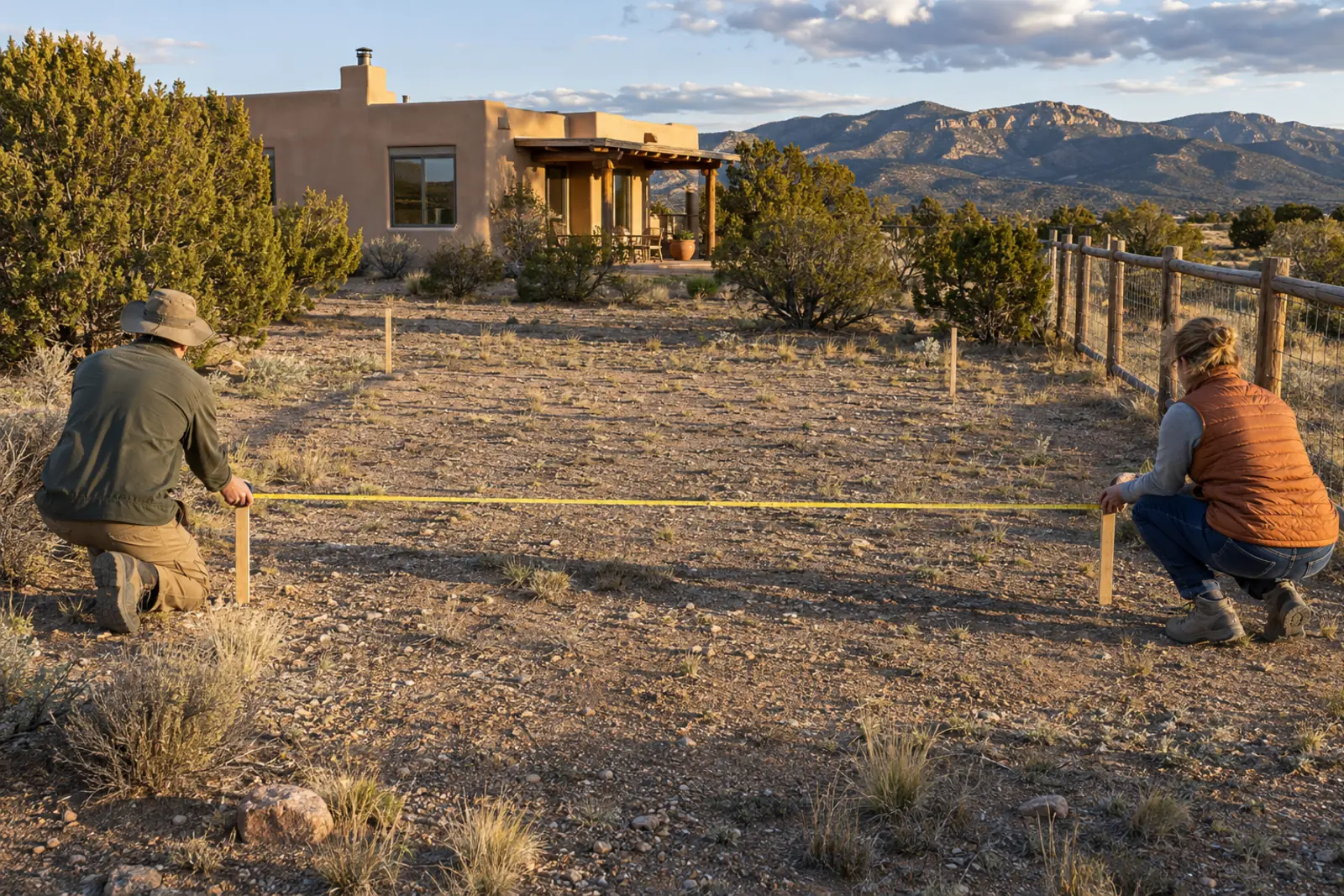
One thing to watch in the Placitas area specifically: parcels often have irregular shapes due to terrain, arroyos, and the way older subdivisions were platted around natural features. A parcel that looks like it has plenty of room for a barn may have a setback constraint on the only flat buildable area once you account for all four property lines and the road right-of-way. Walk the parcel with a tape measure and a copy of the setback standards before you commit to any specific building location.
Building Permits for Horse Facilities in Sandoval County
New Mexico state law sets a threshold below which some residential construction does not require a building permit. For anything substantial - a barn with stalls, a hay barn, a covered arena section, a tack room addition - a building permit will almost certainly be required. The process in Sandoval County involves submitting plans, paying a fee based on the valuation of the structure, and scheduling inspections at key stages of construction. For horse facilities, the relevant inspections typically cover foundation, framing, and final. If the structure includes plumbing - a wash rack, a utility sink in the tack room - plumbing permits and inspections are required separately.
Agricultural structures have historically been treated somewhat differently from residential construction under New Mexico law, with exemptions available for structures used primarily for farming and ranching on qualified agricultural land. Whether a horse facility qualifies for those exemptions depends on how the property is classified, how the structure is used, and how the county interprets the applicable statutes at the time you apply. If you believe an agricultural exemption may apply to your project, ask the county directly - in writing - before you start building. Do not rely on what a neighbor did five years ago or what a seller claims was permitted under a prior exemption.
One common and costly mistake: sellers sometimes have unpermitted structures on a property - a shed, an extra stall, or a shelter added without pulling a permit. That unpermitted work can create problems at resale, with insurance, and with financing. During your inspection period, ask the county for a permit history on the property. If unpermitted structures exist, factor the cost of retroactive permitting or demolition into your negotiation before you close.
Minimum Acreage and Stocking Density for Horses
How many horses can you legally keep on a Placitas property? The honest answer depends on the zoning district, and you need to check the current code rather than rely on a general rule. Agricultural zoning in Sandoval County has historically been more permissive than residential zoning, with livestock numbers tied to lot size. Some residential districts allow a small number of horses per acre as a matter of right; others require that you meet a minimum parcel size before keeping horses at all.
The practical floor for most horse owners is at least two to five acres for a single horse - not because county rules always require it, but because that is what works ecologically in the high desert around Placitas. The pasture management article on this site covers the land-to-horse ratio in detail from an ecological standpoint. The zoning angle is a separate constraint that operates on top of that: even if the land could support one horse on a smaller parcel, the zoning district may require a larger minimum lot, and even if zoning allows ten horses on five acres, the land cannot support that without significant feed supplementation and intensive manure management. Both constraints apply simultaneously and independently.
Septic Permits: The New Mexico Environment Department's Role
Building a new structure with plumbing on a Placitas property - or replacing an existing septic system - requires a permit from the New Mexico Environment Department (NMED), not just a county building permit. NMED's Ground Water Quality Bureau regulates on-site liquid waste disposal systems, which is the regulatory term for what most people call a septic system.
The permitting process involves a site evaluation to assess soil conditions and permeability, a design that meets NMED's standards for the number of bedrooms or fixture units being served, and inspection during installation. Setback requirements apply: a septic system must maintain minimum distances from property lines, water supply wells, water features, and other structures. Those setback distances are set by NMED regulation, not by county zoning, and they apply regardless of what the county zoning says about structure placement.
For a horse property buyer, the relevant questions are these: Is the existing septic system permitted and in compliance? Has it been inspected recently? Is there a perc test on file showing that the soil will support the system size? If you plan to add a dwelling unit - a guesthouse, a casita, or a manager's quarters - does the existing system have capacity for the additional load, or will a new system be required? Answers to these questions affect both the cost of your planned improvements and the timeline for getting permits approved.
Horse facilities themselves - barns, wash racks, arenas - generate a different category of wastewater and solid waste than a dwelling does. Wash rack drainage needs to be managed in a way that keeps contaminated runoff out of the groundwater. NMED has guidance on this, and Sandoval County may have additional requirements. If you plan a wash rack or other facility that generates liquid waste from horse care activities, check with both the county and NMED before you finalize your design.
Well Permits and the Office of the State Engineer
New Mexico water law is prior appropriation - the state owns the water, and you need a permit to drill a well or use groundwater for most purposes. Domestic well permits for residential use, including watering livestock, are issued by the New Mexico Office of the State Engineer (NMOSE). The water article on this site covers the practical side of wells and water supply in depth. From a permits and zoning standpoint, what matters is this: a property's existing water rights, including the permit for any existing well, should be verified during due diligence.
If you plan to drill an additional well or expand water use beyond what the existing permit authorizes, that requires a separate application to NMOSE - and in some water basins near Placitas, additional well permits may be difficult to obtain due to prior appropriation constraints from existing senior rights holders. Confirm the status of any existing water permits before you close, and understand what the permit authorizes before you commit to a water infrastructure plan that depends on more capacity than it covers.
HOA Rules and Deed Restrictions: Often More Restrictive Than County Zoning
A significant portion of developed land in Placitas sits within platted subdivisions that were recorded with CC&Rs. These private covenants run with the land, meaning they bind every future owner regardless of whether that owner was aware of them at purchase. They are enforced not by the county but by the homeowners association or, if no active HOA exists, by any individual property owner in the subdivision with legal standing.
Horse-related restrictions in Placitas subdivision CC&Rs vary widely. Some older agricultural subdivisions were platted specifically to accommodate horses and have no meaningful restrictions beyond those in county zoning. Others limit the number of horses per parcel, require that horses be kept a minimum distance from neighboring residences, prohibit commercial boarding or training operations, or require that structures meet specific architectural standards. A few subdivisions have rules that effectively prohibit horses altogether, though those are less common in a community with Placitas's agricultural history.
The key point: CC&Rs are separate from and additional to county zoning. Even on a parcel with agricultural zoning, if the recorded subdivision covenants limit horses to two per lot, that covenant controls. Your title company will identify recorded CC&Rs as part of a standard title search, but reading and understanding them is your responsibility - or your attorney's. Do not assume that because county zoning is permissive, the subdivision rules will be as well.
If a subdivision has an active HOA, the HOA may have also adopted architectural guidelines or use rules beyond what the original CC&Rs require. Those documents are typically available from the HOA management company or the board. Ask for them specifically, read them carefully, and ask pointed questions about what they mean for your planned use before you close escrow.
Easements and Access: The Hidden Layer
Rural Placitas properties frequently carry recorded easements for utilities, access roads, drainage, and sometimes historic uses like acequia water delivery. Easements affect what you can build and where - you generally cannot place a permanent structure over a utility or drainage easement, and you may have obligations related to maintaining access easements that benefit neighboring parcels.
Access easements deserve particular attention on horse properties. If your parcel relies on an easement across another owner's land to reach a public road, the terms of that easement - its width, the uses it permits, and who is responsible for maintenance - affect everything from daily horse trailer access to emergency evacuation. Narrow easements designed for passenger vehicles may not accommodate a loaded stock trailer without damaging the road surface or generating a legal dispute with the easement grantor about what uses are permitted.
Pull the title commitment early in your due-diligence period and read the schedule of exceptions carefully. Easements will be listed there. If any easement is relevant to your planned use, have your attorney review the recorded document - not just the reference to it in the title commitment - before you close.
Practical Steps Before You Make an Offer
Putting this together into a practical checklist: before making an offer on a Placitas horse property where you plan to build, expand, or keep a specific number of horses, work through the following steps in roughly this order.
- Get the parcel ID from the listing or the Sandoval County Assessor's website and look it up on the county GIS portal to confirm the zoning designation.
- Read the applicable section of the Sandoval County Land Development Code for that zoning district - specifically the standards for livestock, accessory structures, setbacks, and lot coverage.
- Ask your title company to run a preliminary title search and flag any recorded CC&Rs, easements, or deed restrictions affecting the parcel.
- Read the CC&Rs in full, paying specific attention to provisions about livestock numbers, structure types, commercial activities, and architectural approval requirements.
- Contact Sandoval County Community Development to confirm permit requirements for any structures you plan to build, and ask whether any existing structures on the property have open permits or unpermitted work on record.
- If the property has an existing septic system, verify that it is permitted with NMED and ask for the permit file, including the design and any inspection records.
- Verify the status of any existing water well permit with NMOSE and confirm what the permit authorizes in terms of gallons per day and allowed uses.
- Walk the parcel with a measuring tape and the setback requirements in hand before you commit to any specific location for a planned structure.
None of these steps requires you to hire professionals - most of the information is public record and freely available. But they do require time, and that time is better spent before you are under contract than after you have committed emotionally and financially to a property.
Working with Sandoval County Community Development
Sandoval County Community Development handles building permits, zoning verifications, and land use applications. The office is located in Bernalillo, the county seat, and can be reached by phone or in person. For complex projects like a large barn addition, an arena with covered sections, or a structure that might qualify for an agricultural exemption, a pre-application meeting with county staff is worth requesting. These are informal conversations where staff can tell you what the permit process will look like, what documentation you will need to submit, and whether there are any red flags with your proposed project before you spend money on design work.
Permit timelines in Sandoval County, like most rural New Mexico counties, are not fast. Plan on weeks to months depending on the project and the current workload at the office. If you are purchasing a property with a plan to begin construction immediately after closing, build realistic permit timelines into your financial and operational plan. Starting construction without permits - or assuming that forgiveness will be easier than permission in a rural county - is a risk that can complicate your title, your insurance, and any future sale.
The county's Land Development Code is periodically amended. Standards that applied when a structure was originally built may differ from standards that apply today. This matters most when you are trying to understand whether an existing structure is legally nonconforming (built under old rules that have since changed) versus simply unpermitted. Nonconforming structures that predate a code change typically have some degree of protection; unpermitted structures do not. The distinction matters for your due diligence and for how you approach negotiating the purchase price.
Frequently Asked Questions
Do I need a building permit to add a horse shelter in Sandoval County?
It depends on the size and permanence of the shelter. New Mexico state law has historically exempted small detached accessory structures below a certain square footage threshold from building permit requirements, but that threshold can change and Sandoval County may have additional requirements on top of the state baseline. A structure with a foundation, permanent framing, or plumbing will almost certainly require a permit. Confirm with Sandoval County Community Development before you start construction - a brief call or email can save significant trouble later.
Can subdivision CC&Rs in Placitas prohibit horses even if county zoning allows them?
Yes. Private deed restrictions and CC&Rs operate independently of county zoning, and the more restrictive provision controls. If the county's agricultural zoning allows ten horses per parcel but the recorded subdivision covenants limit you to two, the operative limit is two. These private restrictions are enforced by neighboring property owners or an HOA, not by the county. Your title search will surface recorded CC&Rs, but you are responsible for reading and understanding them before closing.
How do I find out if there is unpermitted construction on a property I want to buy?
Contact Sandoval County Community Development and ask for the permit history on the parcel by address or parcel ID. The county can tell you what permits have been issued, what inspections were completed, and whether any permits are open or expired. Compare that record against the structures that exist on the property during your inspection period. Resolving unpermitted work typically involves retroactive permitting or removal, and the cost of that resolution should factor into your negotiation before you agree to a price.
Can I operate a horse boarding or training business from a Placitas property?
Possibly, but it requires careful research before you purchase the property for that purpose. Home-based commercial activities are regulated under Sandoval County's Land Development Code and the standards vary by zoning district. Subdivision CC&Rs frequently restrict or prohibit commercial operations in areas that were platted as residential subdivisions. Verify that the zoning permits your intended commercial use and that no deed restrictions prohibit it - both checks need to pass, not just one.
What is the setback requirement for a barn in Sandoval County?
Setback requirements vary by zoning district and are updated when the county amends its Land Development Code, so no third-party source - including this one - should be treated as a definitive answer for a specific parcel. Go directly to the current Sandoval County Land Development Code for the specific district that applies to your parcel, or request written confirmation from Sandoval County Community Development. Keep in mind that setbacks near wells, septic systems, and arroyos may come from state regulations rather than county code, and those may differ from the general structural setbacks in the zoning ordinance.
How do I confirm a property's zoning before making an offer?
Start with the Sandoval County GIS portal, which lets you search by parcel ID or address and view the zoning designation at no cost. For a formal, binding confirmation, request a written zoning verification letter from Sandoval County Community Development - this documents the classification and applicable standards as of its issue date and gives you something concrete to rely on. Build at least two weeks into your due-diligence period to allow time for the county's response, and do not let your inspection contingency expire before you have the answer in writing.
If you are sorting through what a specific Placitas property allows before you decide whether to pursue it, take your questions to Sandoval County's planning and zoning office, check any HOA covenants, and consider a real estate attorney for anything that affects the purchase. This guide cannot give legal advice or speak for the county.